 AuthorPing
Reader guide
Books Like Dune: 10 Series to Read Next
 By James Fleming, founder of AuthorPingPublished
If you've finished Dune and want more, the series Dune readers most often pick up next on Hardcover are Isaac Asimov's Greater Foundation Universe, the Blade Runner novels and George R.R. Martin's A Song of Ice and Fire. All three share Frank Herbert's interest in power, in who secretly holds it and in what it costs the people at the top. The other seven picks range from cyberpunk to epic fantasy, and each one shares at least one thing that made Arrakis hard to leave.
Why are so many readers looking for books like Dune?
Because a lot of people are reading it right now. Dune is number 3 of the 84,810 books on our catalogue by Hardcover readers, with 15,206 readers there. Hardcover is much smaller than Goodreads or StoryGraph, so that is a very large number for it.
AuthorPing's own daily count shows that book's Hardcover readership growing by about 1.9% a week, measured over the last 29 days. That means a steady stream of readers is finishing the desert planet and wondering where to go next, which is exactly who this list is for.
Is there going to be another Dune book?
There is no next main Dune book on our calendar. All six of Herbert's main novels are published, running from Dune to Chapterhouse: Dune, so the story as he wrote it is complete.
The upside of a finished series is that nobody has to refresh a page waiting for book seven. If you stopped partway through, the full Dune reading order is on our series page, and it is worth knowing that the later books jump thousands of years ahead: God Emperor of Dune is set after Leto has ruled for thirty-five hundred years, and Heretics of Dune picks up fifteen hundred years after that.
What should I read after Dune?
These are series that readers of Dune also read on Hardcover, listed with the closest match first. It is not a ranking of which is best, just a guide to what overlaps with what you liked. Each one is introduced through its first book.
1. Greater Foundation Universe by Isaac Asimov
The starting point here is I, Robot, a set of linked stories about robots, humanity and the deep questions of existence. Its blurb promises robots gone mad, mind-reading robots, robot politicians and robots who secretly run the world, all built around Asimov's Three Laws of Robotics.
A Dune reader will recognise the question underneath it all. Herbert's books keep asking who really controls an empire, from the political houses Paul displaces to the conspiracy inside his own circle, and Asimov asks the same thing with machines in place of noble families. It has 6,468 readers on Hardcover.
2. Blade Runner by K.W. Jeter
Blade Runner 2: The Edge of Human goes back into the high-tech, run-down Los Angeles of the film and opens a new chapter for Rick Deckard, the blade runner who hunts renegade androids. This time Deckard becomes both hunter and hunted, racing to prove his own humanity while tracking the most dangerous android of all.
That question of what still counts as human is one Dune fans know well. In God Emperor of Dune, Leto is described as still alive but far from human, with a morality to match his transformation, and this series pushes on the same nerve from a grittier, street-level angle.
3. A Song of Ice and Fire by George R.R. Martin
A Game of Thrones follows Lord Eddard Stark, who is made Hand of the King and finds treachery waiting for him at court. Meanwhile the heir of a deposed Dragon King has grown up in exile and is claiming the Iron Throne.
If the part of Dune you liked best was House Atreides being betrayed by rival houses, this is the closest match on the list for politics. It swaps spaceships for swords, but the noble families, divided loyalties and displaced heirs will feel very familiar. Its first book has 10,436 readers on Hardcover, more than any other first book here except one.
4. Sprawl by William Gibson
Neuromancer is about Case, once the sharpest data-thief in the matrix, until the wrong people crippled his nervous system and shut him out of cyberspace. A mysterious employer hires him for a last-chance run at an extremely powerful artificial intelligence, with a street-samurai called Molly watching his back.
The setting is a near-future digital world rather than a galactic empire, so the texture is very different. What carries over is the sense of schemes inside schemes, with hidden employers and powerful forces moving people like pieces, and the reputation of a book that changed its genre, much as Herbert's saga is called one of the most significant in literary science fiction. It has 6,657 readers on Hardcover.
5. The Enderverse by Orson Scott Card
In Ender's Game, government agencies breed child geniuses and train them as soldiers to defend against a hostile alien race. Young Andrew "Ender" Wiggin is drafted to the orbiting Battle School, where children fight mock battles in zero gravity.
Dune opens with a boy heir set on the path to a destiny far bigger than he could have imagined, and later turns on twins whose abilities make them valuable to the people around them. Ender's story is built on the same idea of a gifted child shaped and used by powerful institutions. It has 8,315 readers on Hardcover.
6. Hyperion Cantos by Dan Simmons
Hyperion is set in the 29th century, when the Hegemony of Man spans hundreds of planets linked by farcaster portals and keeps an uneasy alliance with a civilisation of AIs. On the eve of an invasion, a final pilgrimage sets out for the Time Tombs, which move backwards in time and are guarded by a legendary creature called the Shrike.
This is the pick for readers who want Dune's galactic scale, its rival factions and its blend of religion and politics. A pilgrimage to a feared, worshipped place is not far from the fervour the Fremen feel for Muad'Dib. It has 6,452 readers on Hardcover.
7. Remembrance of Earth's Past by Cixin Liu
The Three-Body Problem begins with an alien civilisation on the brink of destruction capturing a signal from Earth and planning an invasion. On Earth, people split into camps: some want to welcome the newcomers and help them take over, while others want to fight.
The later Dune books think in thousands of years and argue about humanity's long-term survival, which is the whole point of Leto's Golden Path. Liu's series shares that enormous scope and that question of what humanity should become. Its first book has 10,035 readers on Hardcover.
8. The Witcher by Andrzej Sapkowski
In Blood of Elves, a long peace between humans, dwarves, gnomes and elves has collapsed. Geralt of Rivia, the hunter known as the Witcher, has been waiting for the birth of a prophesied child who could change the world for good or evil, and that child is now being hunted.
This is fantasy rather than science fiction, but prophecy runs right through Dune, from Paul's rise to Sheeana fulfilling an old prophecy on Rakis. A child whose powers make them a target will also remind you of Leto and Ghanima. It has 4,728 readers on Hardcover.
9. The Stormlight Archive by Brandon Sanderson
The Way of Kings is set on Roshar, a world of stone and storms where tempests have shaped ecology and civilisation alike. Animals hide in shells, grass retracts into the ground, and cities exist only where the land offers shelter. Centuries after the fall of the Knights Radiant, their Shardblades and Shardplate still remain.
For many readers, the real main character of Dune is Arrakis itself, a world where the desert and the spice decide everything. Sanderson builds a world just as ruled by its environment, so if the sandworms and the stillsuit logic were your favourite part, start here. It has 9,613 readers on Hardcover.
10. Harry Potter by J.K. Rowling
Harry Potter and the Philosopher's Stone starts with Harry living a miserable life with the Dursleys, sleeping in a tiny closet at the foot of the stairs, until a mysterious letter arrives by owl. It invites him to a place that will change everything.
A closet under the stairs is a humbler starting point than heir to a noble family, but the shape is the same: a boy who discovers he is meant for something far bigger. It is lighter and younger in tone than anything Herbert wrote. It also has the most Hardcover readers of any first book here, 16,709, even more than Dune's 15,206.
Where should I start?
Every series above begins with the book named in its section, so you can start there. If your favourite part of Dune was the scheming, try A Song of Ice and Fire or Greater Foundation Universe. If it was the sheer size of the universe, go for Hyperion Cantos or Remembrance of Earth's Past, and if it was the planet itself, try The Stormlight Archive.
How do I hear about new books in these series?
Several of these series are still growing, and it's easy to miss a new book until it's been out for months. AuthorPing notifies you when a series or author you follow has a new book coming out and shows a countdown to every release, and it's free on iPhone and Android.
About Frank Herbert
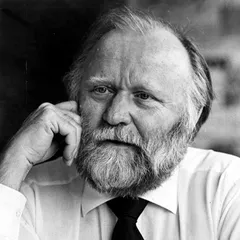
Frank Herbert (1920-86) was born in Tacoma, Washington and worked as a reporter and later editor of a number of West Coast newspapers before becoming a full-time writer. His first SF story was published in 1952 but he achieved fame more than ten years later with the publication in Analog of 'Dune World' and 'The Prophet of Dune' that were amalgamated in the novel Dune in 1965. Every Dune release date
Questions readers ask
What should I read after Dune?
Readers of Dune most often move on to Isaac Asimov's Greater Foundation Universe, starting with I, Robot, then the Blade Runner novels and A Song of Ice and Fire. For galactic scale, Hyperion Cantos and Remembrance of Earth's Past are strong picks.
Is there going to be another Dune book?
There is no next main Dune book on our calendar. Frank Herbert's six main novels, from Dune to Chapterhouse: Dune, are all published.
What order should I read the Dune books in?
Start with Dune and continue through the six main novels in publication order. The full Dune reading order is on our series page.
Is A Game of Thrones like Dune?
In its politics, yes. A Game of Thrones is built on noble houses, treachery at court and a displaced heir claiming a throne, which echoes the betrayal of House Atreides, though it is fantasy rather than science fiction.
What fantasy series are like Dune?
The Stormlight Archive shares Dune's focus on a world shaped by its harsh environment, and The Witcher shares its themes of prophecy and a gifted child hunted for their powers.
James is the founder of AuthorPing. He's a lifelong reader and writer, and his goal is to help millions of readers around the world keep up with their favourite authors and series. More about AuthorPing
 Scan with your phone